Hotels · Aparthotels · Short-Stay
Your website sends guests to Expedia.
Most short-stay operators I look at are quietly routing their own traffic to the booking platforms, and paying 15 to 20% of every night for the privilege. That is the problem this build exists to fix.
Builds are quoted per project after a six-tap estimate, and the care plans that keep them running are $149 to $749 a month.
See it working before you talk to me
The Kinsley is a demonstration property I built to show exactly what this looks like finished. It is a fictional West Loop aparthotel (nothing on it is bookable), but every mechanism is real: the booking bar that never scrolls away, the direct-booking case with an actual number attached, accommodation pages per layout, and a neighborhood list a search engine can actually read.
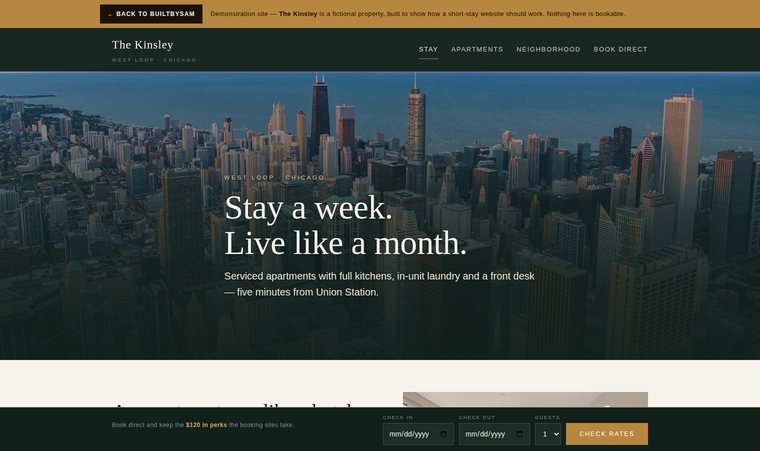
One thing you will notice is missing: guest reviews. The section is deliberately empty, with a note saying so. Inventing reviews for a hotel that does not exist is exactly the behaviour this whole approach argues against.
Or send me your URL first
Before any of this, I will tell you specifically where your current site is handing guests to the booking platforms, and roughly what it is costing you. No charge, no sales sequence, no call required. I send it back in writing.
The math nobody runs
Take a $180 average nightly rate and a five-night stay. That reservation is about $900, and the platform commission on it is $135 to $180, money you keep entirely if the guest books with you instead.
| Direct bookings recovered per month | Kept per year | What that pays for |
|---|---|---|
| 10 | $16,200 to $21,600 | The entire build, in the first year |
| 20 | $32,400 to $43,200 | The build plus years of care |
| 30 | $48,600 to $64,800 | A standing line on your P&L |
This is traffic you already pay to acquire. The only question is who takes the cut when it converts.
What I find on almost every short-stay site
- The FAQ tells guests to manage their stay through the platform. Your own site, instructing people to book somewhere that charges you commission.
- No reason to book direct. No best-rate promise, no perk, no number: nothing that beats the platform a guest already trusts.
- One structured-data record for multiple buildings, so search engines read two properties as one place and neither ranks properly.
- Contradictory addresses between the page text and the code. Google reads the code, and a mismatch suppresses map rankings.
- Photography named after a previous operator, which is both an SEO signal and an unresolved licensing question.
- A booking widget that moves: scrolls away, appears twice, or lands on a different page mid-decision.
None of that is theoretical. Every item on that list is something I have measured on a live operator's site and then fixed.
What the build includes
- A booking bar pinned to every page at every scroll position, with one availability search that never moves
- A direct-booking case with an actual number attached, not a “best rate guaranteed” promise the guest cannot price
- Per-property
Hotelstructured data with the correct address, so each building ranks as itself - Accommodation pages per room type (studio, one-bed, two-bed), because that is how people actually search
- Extended-stay and family pages, which is where the margin usually hides and where most sites say nothing
- A researched neighborhood guide with measured walking times, plus a crawlable list of every place
- Your real guest reviews, with rating markup
- Handoff to whatever reservation system you already run: Guesty, Cloudbeds, Mews and similar
- WCAG 2.2 AA, a static build with no external JavaScript, and an automated quality gate that fails if a known defect returns
- A 301 map from every existing URL, so nothing you have earned in search is lost at switchover
Multi-property and multi-market
The system is built for operators with more than one building. Additional properties reuse the design system, so a second and third market cost a fraction of the first, typically around a quarter of the original build, because you are buying local research, content and search targeting rather than a new design.
What it costs
A single-property build with booking integration and structured data generally runs $12,000 to $18,000. A multi-property build with per-location research and neighborhood guides runs $18,000 to $25,000. Photography and video are quoted separately. Ongoing care starts at $149/month.
Every figure is fixed before work starts. There is no discovery call designed to find out what you can afford.
Send me your URL and I will tell you, specifically, where your site is sending guests to the platforms and what it is costing you. No charge and no sales sequence.
See the work · A case study · Care plans · All website services
Straight answers
Common questions
How much does a hotel website cost?
A multi-property hotel or short-stay site with booking integration, per-property structured data and a researched neighborhood guide typically runs $12,000-$25,000 one-time, depending on the number of properties and whether photography is included.
Will it work with my booking engine?
Yes. The site hands off to whatever reservation system you already run - Guesty, Cloudbeds, Mews or similar - so you are not changing your operations to change your website.
How long does it take?
Two to four weeks for a single property, longer for multi-location builds. Every existing URL is mapped to a redirect first, so nothing already earned in search is lost at switchover.
Your move